Research
I publish what survives honest evaluation, including when that means retracting a result.
Two published papers, one more under review, one granted patent and one pending. The published pair are a hybrid architecture for unstained cell imagery and the undergraduate robotics work the patent came from; the paper under review is the osteoporosis work. What follows is a thesis in progress, and an audit that invalidated a prior result before it invalidated itself.
Publications
Two published, one under review
-
Neural Computing and Applications, Springer Nature
Fuzzy deep LSTM for cancer cell death analysis
Published — citation pending
-
2022 6th International Conference on Electronics, Communication and Aerospace Technology (ICECA), IEEE, pp. 1153–1157
FlowerBot: a deep learning aided robotic process to detect and pluck flowers
Published 1 December 2022 — cited by 7
-
MS thesis research, University of Toledo
Hip osteoporosis risk from CT imaging and clinical data
Under review
Patent pending; $50K NSF I-Corps grant; featured in UToledo News
-
University of Pennsylvania
External validation
The brain tumor classifier was validated externally, outside the group that built it.
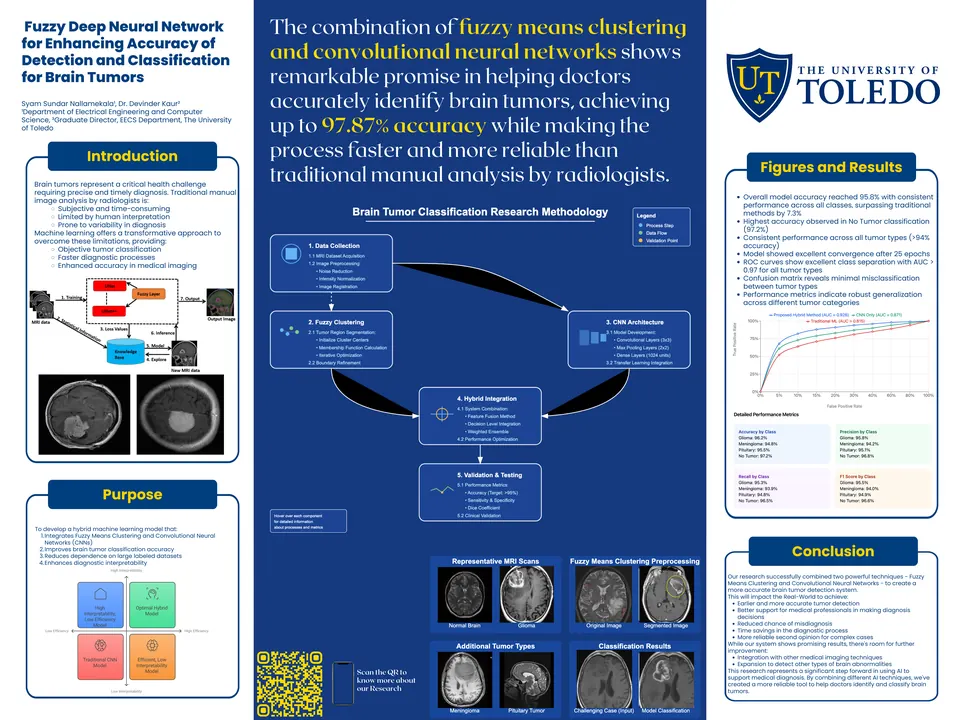
Poster
Fuzzy deep neural network for brain tumor detection and classification
University of Toledo, Dept. of EECS — with Dr. Devinder Kaur
Presented at NCUR 2025, Pittsburgh
How I work
Method, and what I do when it fails
-
I audit inherited work before I extend it
The osteoporosis pipeline came to me from a prior student. Auditing it end to end surfaced a data-leakage bug — the model was effectively seeing test data during training. After correction a previously reported headline result did not survive, and a simpler model proved the more trustworthy one.
-
I replace single splits with repeated cross-validation
One train/test split made the initial osteoporosis results look strong. Repeated cross-validation showed most of that was noise, and confirmed genuine signal only under stricter testing.
-
I report conditions alongside numbers
Every figure on this site carries what it was measured on. The traffic model reports 8.92% MAPE and, in the same breath, that it has 38,375,647 parameters trained on six examples and no baseline to beat.
-
480+ documented research hours at ODOT
Across three assignments, with three milestone presentations to stakeholders and a final technical report alongside the delivered prototype.